


Expo 2 Ruedas ran from 29 October to 1 November at Corferias in Bogotá, and the stand came down in half a day. What is left is a stack of orders taken at the booth. Whether a show worked is measured by how many people walked in over four days; whether the business works is measured by what ships after the hall empties.
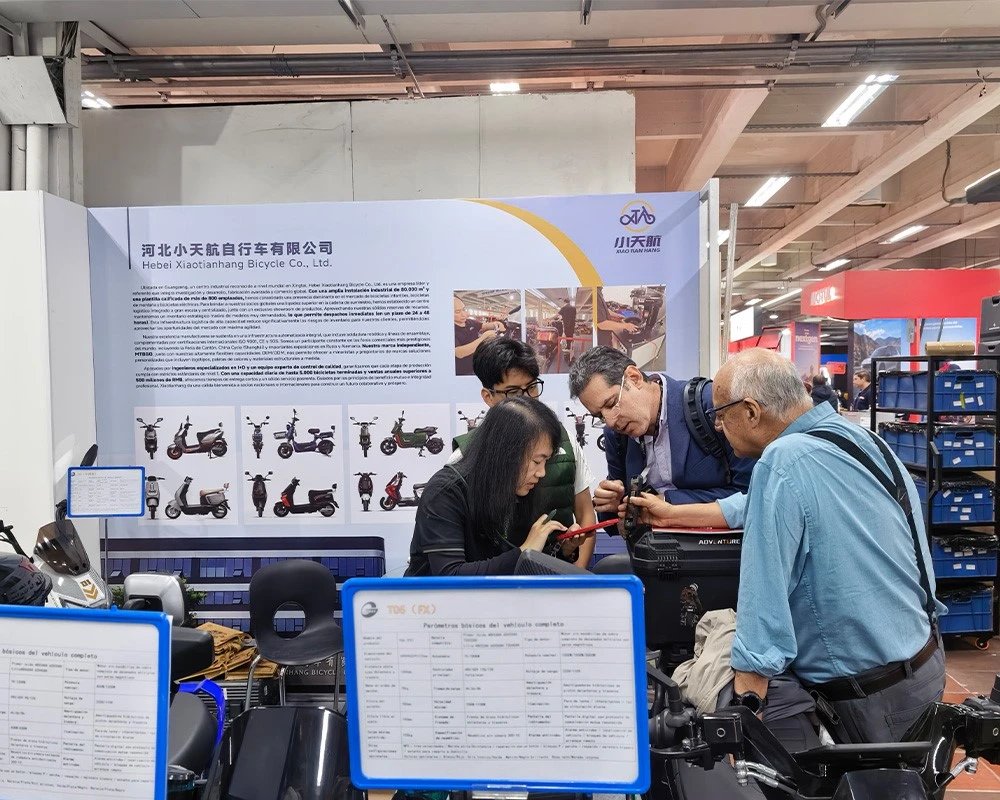
At stand 240 in hall H6 the bicycle and electric scooter lines stood together, with XIAOTIANHANG and Electric Bicycle Pioneer across the back wall: mountain and e-assist bikes hung on the back wall, road, folding, kids and city models flanked them, and three electric scooters sat at the front edge of the stand. The layout had a practical reason - the buyers are the same people. A shop that sells bicycles is also selling electric scooters, and one buying trip should cover both categories rather than two walks across the hall.
Colombian buyers ask precise questions. The first is almost always the battery: does it come out for charging, how far on a charge, what does a replacement cost, can it be repaired locally. The second is gradient - Andean roads are narrow and the climbs are long, so buyers ask directly whether motor power is enough, whether a sustained climb overheats it, whether the brakes hold on the way down. The third is parts: mudguards, racks, mirrors and top boxes are necessities here, and the question is whether common parts can be supplied for years rather than one season.
Those questions decide what goes on the stand. Every display unit could be sat on, rolled, its battery compartment opened on the spot, its charging inlet shown plainly. The specification sheet sat on the table and was rarely opened; buyers preferred to crouch and look at the weld bead, at whether the harness was tied down, at how much travel the rear shock had.
Voltage and plugs were among the most repeated technical questions of the four days. Colombian mains run mainly at 110 volts and 60 hertz on a North American style socket, while the export configuration the factory builds most often is 220 volts; when both exist in one batch of electric scooters, cartons must be split by destination city and never mixed. Explaining that at a booth costs far less than adding a dispute clause later.
Over the four days more than one buyer placed an order, and some signed on the spot. Signing at a show is not a matter of salesmanship but of three answers that have to come immediately: can the specification be changed, when can it be scheduled, and who is responsible when something fails. The first two depend on the line, the third on the spare parts list - and a supplier who cannot answer the third will not be signed with, however low the price.
Scheduling can be worked out at the booth. The export electric scooter line runs a seventy-two second takt, four hundred units a shift, so five hundred units occupy a little over one production day; the drift trike line turns out six hundred and sixty a day; the aluminum e-motorcycle line manages twenty-five, because every battery box is matched individually and every unit gets a power-on and a rain test. When a buyer asks how long delivery takes, the real answer is how many production days this order occupies and which slot it lands in - a number that needs no meeting to produce.
Buyers who signed usually changed three things: battery capacity, rear rack and top box, and colour. The more changes, the earlier the part numbers have to be locked, or the whole batch waits for one missing component when it reaches the line. That is why the first week after a show is not for celebrating: every order's specification, voltage and packing method gets checked line by line and the part numbers locked into the schedule. Verbal promises about changes have to reach paper at that point.
Taking the stand down is the start, not the end. Sample units and spare parts lists go out, certification documents get prepared, and interested buyers come to walk the plant. Hebei Xiaotianhang Bicycle Co., Ltd., which operates Guangzong Zhaoyue Factory under Tianhang Group, builds bicycles and electric scooters in one compound and ships CBU, SKD or CKD; kits are matched to each container loading plan, cartons are split by destination city, and dimension check sheets and lithium battery transport papers travel with the goods. Buyers can name the process step they want to inspect on a plant visit, or prove batch consistency with a single container first.
Contact
Nickie | +86 193 2201 4900 | nickie@hbxiaotianhang.com


