

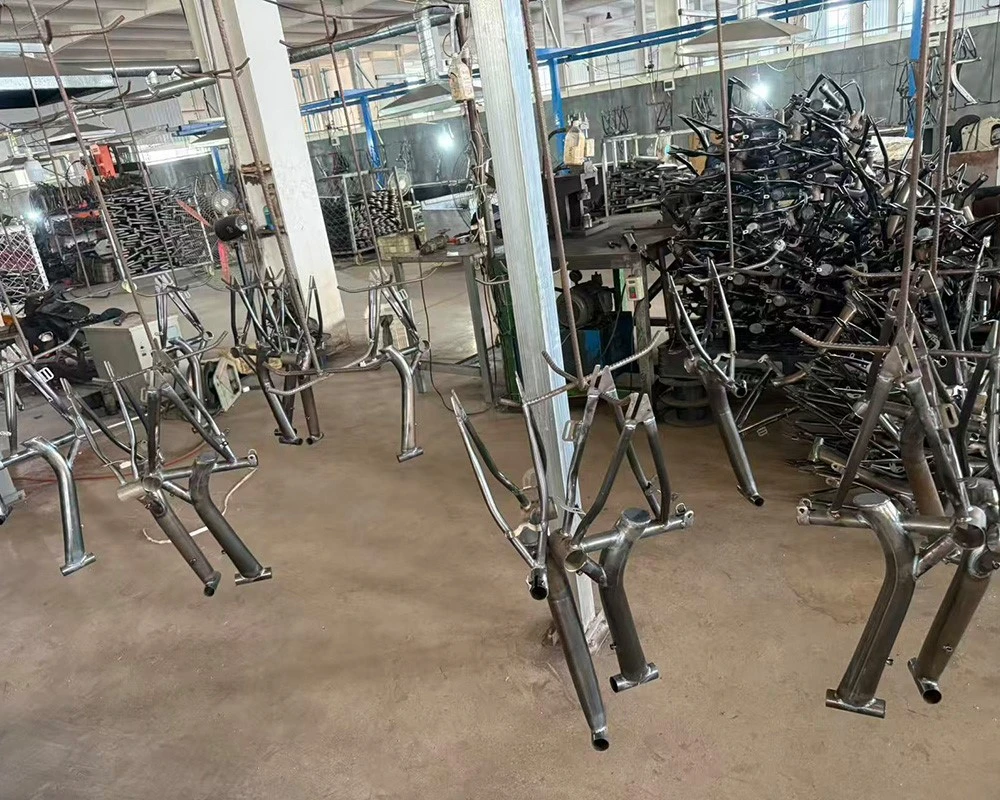
Efficiency bottlenecks in electric motorcycle production rarely sit inside a single process. They sit in the waiting between processes: frames waiting for pre-treatment after welding, frames waiting for components before assembly, sample builds waiting for a gap in the production line. None of this shows up in equipment specifications, yet it determines how long a unit takes from order to shipment. Keeping welding and assembly on one site is how that waiting gets compressed.
The expansion adds an aluminum alloy frame welding station, paired with post-weld processing. After welding, aluminum frames carry heat distortion and welding residue; without cleaning, straightening, and pre-treatment completed on the same site, frame geometry and coating adhesion can drift during transport and queuing. Because the welding station and post-weld processing sit next to each other, the interval between welding and entry into coating pre-treatment is controllable, rather than dependent on an external supplier's schedule.
The bicycle assembly line and the existing electric two-wheeler line run alongside the new welding capacity. The added electric motorcycle line does not replace existing output; it runs in parallel, with welding and assembly completed within the same plant. For buyers, the practical effect is a short link between sampling and volume production: samples are validated on the production line, and the process parameters that pass validation carry directly into batch orders, without re-aligning two separate systems.
The line structure of this plant reads in three layers. At the front sits a shared welding stage: one aluminum alloy frame welding station with its post-weld processing serves both electric and bicycle frames, with welding windows allocated according to the order mix. The second layer is the electric motorcycle assembly line, handling wiring harness routing, suspension and wheel installation, brake adjustment, and exterior components. The third is the bicycle assembly line, running in parallel, with the two categories coming off separate lines and packed separately. Shared welding with separate assembly is the basic architecture here.
Because welding is shared capacity, output figures have to be counted at plant level. Roughly 1,000 units a day and about 30,000 units a month describe the combined output of those three layers, and over 300 production days the plant's annual capacity comes to approximately 300,000 units. How many welding windows and how much assembly pace each category receives follows the order mix; no fixed ratio is preset, and the split is confirmed order by order at quotation and scheduling. Output for the electric motorcycle line alone depends on the capacity allocated to it in a given period. These figures assume standard configurations and uninterrupted scheduling; where special frame specifications, custom colors, or modified electrical configurations are involved, output is re-confirmed once the configuration is settled. Lead time is confirmed against order quantity, and larger batches occupy a longer production window.

Configuration flexibility is the other use of this electric motorcycle line. Private label production, color changes, and configuration adjustments are handled at the order stage, and mixed-configuration orders can run on the same line without opening a dedicated line for each variation. Finished units are packed according to order configuration for full-container shipment, which suits importers and distributors placing consolidated orders, as well as buyers testing a market with a small first batch before moving to volume.
For overseas buyers, seeing the line is itself a screening criterion. The factory receives customer audits, and the welding station, assembly line, and finished-goods area are open for inspection while production is running. Single-site welding and assembly also make traceability straightforward during an audit: a deviation in frame geometry or assembly sequence can be located at the station where it occurred, and corrective action stays within one production team.
Keeping welding, assembly, and audits in the same space ultimately affects how predictable delivery becomes. Sampling is fast because samples do not queue behind the production line; production is fast because frames do not travel between plants; lead time is negotiable because the scheduling window sits in-house. Together, these are what an electric motorcycle line expansion actually changes for an order.
Demand for efficient and reliable two-wheel mobility keeps shifting, and whether a production layout can follow the order mix says more about a factory than capacity at a single point. With this expansion complete, Guangzong Zhaoyue Factory - one of the production bases of Hebei Xiaotianhang Bicycle Co., Ltd. under Tianhang Group - runs aluminum alloy frame welding, post-weld processing, and final assembly as one continuous layout on a single site, sharing welding capacity between its electric and bicycle lines, taking on private label, color, and configuration orders with full-container shipment and customer audits, and supplying practical, reliable two-wheel products to domestic and international buyers.
Contact
Tianhang Group · Hebei Xiaotianhang Bicycle Co., Ltd. · Guangzong Zhaoyue Factory Nickie | +86 19322014900 | nickie@hbxiaotianhang.com


