


Manufacturing capability in the electric motorcycle segment is shaped less by individual machines than by how production steps are connected. Frame fabrication, component preparation, final assembly, and pre-delivery checks each influence dimensional accuracy, build consistency, and the lead time a factory can commit to. Integrating these steps within one site has therefore become a practical way for manufacturers to improve control over output quality.
The frame is the structural reference point of an electric motorcycle. In aluminum alloy frame welding, fixture design, welding sequence, and heat input all affect how much a frame moves after cooling. A frame that deviates from its intended geometry complicates suspension mounting, wheel alignment, and body panel fit at later stages. Stable fixturing and a defined welding sequence are what keep frame geometry repeatable from unit to unit.
Final assembly turns a frame into a rideable electric motorcycle. Stations along the line handle wiring harness routing, suspension and wheel installation, lighting, brake adjustment, and exterior components. The sequence and balance of these stations determine daily output, and they also determine whether every unit leaves the line with the same assembly quality.
Placing frame welding and final assembly in the same plant shortens internal logistics and removes a handover between facilities. Frames move directly from welding into preparation and assembly, sampling cycles for new configurations become shorter, and any dimensional issue can be traced to a specific station instead of being investigated across two sites.
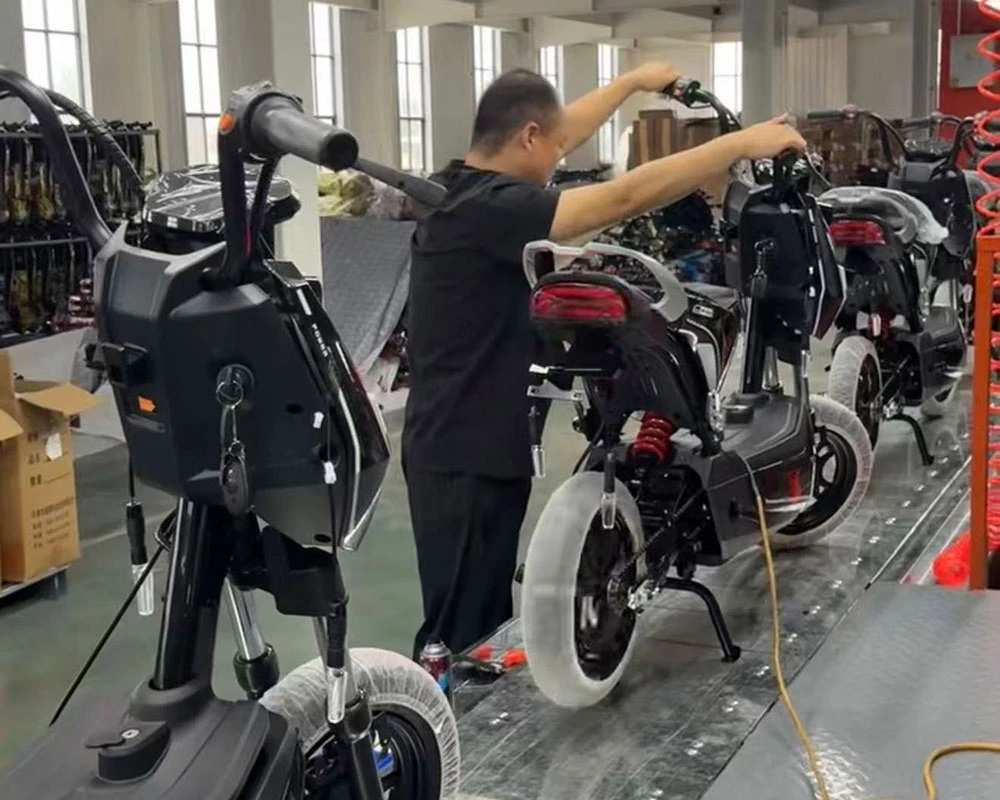
Capacity and lead time are best read separately. The plant runs one aluminum alloy frame welding line and one final assembly line, supporting approximately 400 units per day under standard configurations, or roughly 120,000 units a year across 300 production days. For orders of up to 400 units, the assembly stage is completed within one production day, with the overall lead time driven mainly by material preparation and shipping arrangements. Larger batches extend the production window, and lead time is re-confirmed against order quantity. Orders involving non-standard frame specifications, custom colors, or modified electrical configurations enter the schedule once the configuration is confirmed, with delivery confirmed in writing.
Configuration flexibility speaks to how buyers build their own range. Private label production, color changes, and component configuration adjustments are handled at the order stage rather than requiring a dedicated line for each variation, and mixed-configuration orders can run on the same line. Finished units are packed according to order configuration for full-container shipment, which suits importers and distributors placing consolidated orders, and explains why small trial batches are not pushed behind larger ones in the queue.
Traceability is the practical benefit of single-site production. Because welding and assembly share one plant, a deviation in frame geometry or assembly sequence can be identified at the station where it occurred, and corrective action stays with one production team rather than being coordinated across suppliers.
Demand for efficient and reliable two-wheel mobility continues to reshape how electric motorcycles are produced, with system integration, process control, and delivery reliability carrying more weight than capacity alone. Hebei Xiaotianhang Bicycle Co., Ltd. operates its own production base, backed by 20 years of bicycle manufacturing experience and an 80,000 m² factory, and supplies electric motorcycles, electric bicycles, and bicycle products to domestic and international markets, with a focus on practical, efficient, and reliable transportation solutions.
Contact
Hebei Xiaotianhang Bicycle Co., Ltd. Nickie | +86 19322014900 | nickie@hbxiaotianhang.com


